Dragon Goad Tribal
How to Pilot: Mulligan & Early Turns
Igniting the forced combat engine and fueling your draconic card-draw payoff.
The Perfect Opening Hand (The Mulligan)
When piloting a Firkraag Dragon Goad deck, your opening hand dictates your entire mechanical pacing. Because our endgame relies on maintaining a massive board of evasive dragons while holding up protection, you cannot afford a slow start. Your ideal 7 cards must contain:
- At least 3 Lands: Crucially containing early red mana
 to hit your double and triple-pip dragon requirements later.
- Early Acceleration: A 2-mana rock like Arcane Signet, Izzet Signet, or Talisman of Creativity to get Firkraag out ahead of schedule.
- Cheap Combat Setups: A low-cost enabler like Alexios, Deimos of Kosmos or an aggressive aura like Shiny Impetus to guarantee opponents start attacking early.
Mulligan Rule: If your hand contains multiple 6+ mana dragons and zero acceleration or early goad pieces, throw it back. Shipping a hand of uncastable bombs for a fresh 6 with active mana rocks and low-cost interaction will win you significantly more games.
Early Game Strategy (Turns 1-3)
Your main goal in the first three turns is rapid resource deployment and setting up the political landscape, not raw dragon aggression. Do not rush out your high-cost threats blindly without establishing a political buffer.
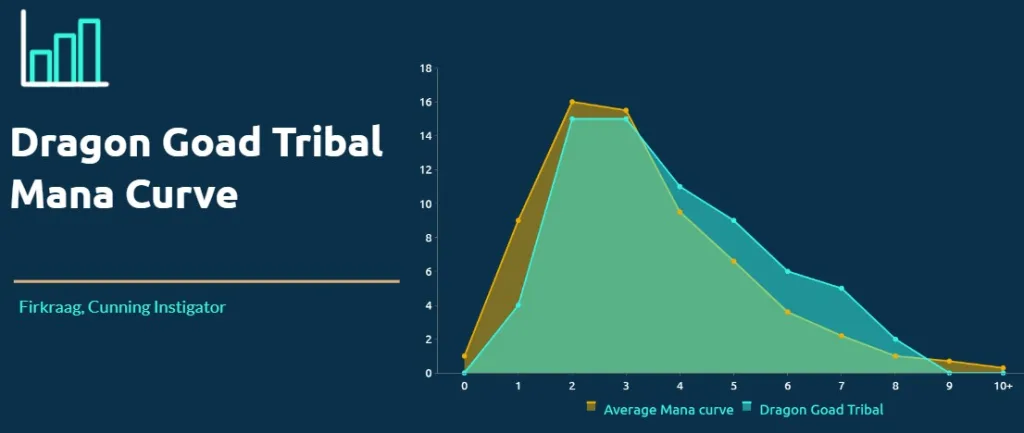
- Turns 1 & 2: Lay down your tapped dual lands early (like Izzet Boilerworks or Ferrous Lake) to ensure your colors are fixed. Deploy your mana rocks immediately to jump the curve.
- Turn 3: This is your pivotal setup turn. Cast cost reducers like Dragonlord’s Servant or highly efficient engines like Alexios, Deimos of Kosmos. If you decide to deploy an early combat modifier now, remember that you are drawing immediate attention to the combat phase. Dropping a turn-3 Public Enemy on a player’s utility creature will instantly paint a target on your back, so make sure you have an active protection spell like Stubborn Denial ready in hand, or enough open mana to safely shield Firkraag when he lands soon after.
Core Deck Highlights & Pillars
The essential pillars that maximize Firkraag’s engine over the original precon tech.
| Core Inclusion | Precon Outcast | The Core Strategy |
|---|---|---|
| (CORE ENGINE) | (Dangerous Chaos) |
Perpetual Card Draw: Warmonger Hellkite forces attacks but doesn’t goad, meaning opponents can swing back at you. Alexios passes around the table, grows exponentially, and forces your opponents to attack each other. Firkraag Triggers: Because he must attack your opponents every turn, he guarantees up to three extra cards before your upkeep even begins. |
| (TEMPO SWEEP) | (Mana Bottleneck) |
Asymmetrical Clear & Ritual: Thunder Dragon is too slow at 7 mana. Desolation of Smaug costs only 4 mana, deals the same 3 damage to non-dragons, and breaks the game wide open. Mana Refund: Upon entering, it adds to your pool, essentially letting you clear the board for free and drop another threat immediately. |
| (PREMIER SHIELD) | (Anti-Synergy) |
Efficient Board Protection: Ryusei requires a death trigger to wipe ground targets, destroying the very creatures you want to goad. Stubborn Denial provides instant protection. Ferocious Efficiency: Because Firkraag scales past 4 power rapidly, this noncreature counterspell reliably functions as a hard counter for just one single blue mana. |
Why are these core to the build?
- Lowered Mana Bottlenecks: Trading clunky 6 and 7-mana components for streamlined engines keeps your hand fluid and reduces dead turns.
- Guaranteed Goad Value: Unlike random combat triggers, elements like Alexios ensure that opponents are mathematically forced to trigger Firkraag’s draw criteria every turn cycle.
- Holding Up Interaction: Running ultra-efficient interaction pieces ensures you can comfortably deploy your massive airborne threats while maintaining a counterspell safety shield.
Mid-Game & Winning Conditions
Navigating the political crossfire, stealing threats, and closing out the late game.
Mid-Game Strategy (Turns 4-7)
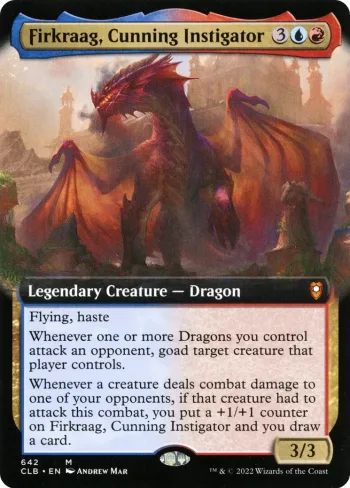
Once you transition into the mid-game, your engine should be fully online. Your main goal here is to establish your Commander, Firkraag, Cunning Instigator, and use your opponents’ combat steps to fill your hand. However, do not become greedy—flying too close to the sun will cause the table to band together against you.
- Farm the Triggers Safely: Use your cheap evasive threats like Sprite Dragon or Chaos Dragon to poke open opponents. Goad their biggest threats away from you. Every time they hit each other, Firkraag rewards you with raw card advantage.
- Maintain the Shield: Firkraag only costs

 . Because he grows larger with every goad trigger, always try to leave a single blue mana untapped. This keeps your opponents terrified of a blow-out counterspell like Stubborn Denial.
- Weaponize Political Tools: This is where your playtested secret tech shines. Drop Public Enemy on a target that cannot easily be blocked, or enchant Firkraag with Furor of the Bitten for just a single red mana to instantly scale him into a massive 6/6 drawing machine.
Closing Out the Game: The Insane 1v1 Interaction
Goading is highly effective at thinning out the table, but it faces a major mechanical limitation: Goad stops working in a 1v1 scenario since your final opponent has no one else to attack but you. To bypass this entirely, the deck relies on a massive, hidden rules interaction to steal victory.
The Late-Game MVP: Hot Pursuit + Mass Goad
This enchantment completely breaks the rules of a standard 1v1 showdown when paired with a mass-goad spell during your main phase. Here is how you execute the ultimate blowout:
- Step 1 (The Setup): Reach the final 1v1 situation where two players have officially been eliminated from the game.
- Step 2 (The Mass Goad): Cast a sweeping spell like Disrupt Decorum or Spectacular Showdown during your Main Phase. This forces every single creature your opponent controls to become goaded.
- Step 3 (The Grand Theft): Move into your Beginning of Combat step. Hot Pursuit triggers. Because your spell goaded their entire board, Hot Pursuit gains control of every single creature they own all at once!
- Step 4 (The Alpha Strike): All their stolen creatures untap and gain haste. You swing their own army straight back at their empty board, completely deleting them from the match!
This interaction completely solves the biggest weakness of the Goad mechanic. By pairing your mass sweeps with Hot Pursuit, you transform defensive boards into an immediate, game-ending assault.
Advanced Rules & Synergy Tips
Mastering the stack and manipulating hidden rules mechanics to outsmart the table.
Piloting this deck effectively requires more than just casting dragons and saying pass. Because the interaction between forced combat, political text, and the stack can get complicated, mastering these advanced interactions will give you a massive edge in your games:
-
1. The Furor 1-Mana Cantrip Trick
When you cast Furor of the Bitten on your own Commander, Firkraag, Cunning Instigator, it forces him to attack each turn. However, because Firkraag already wants to attack to goad your opponents’ creatures, this aura has zero downside. For just
, you permanently turn Firkraag into a 5/5 threat. The moment he attacks and pins a goad counter onto an opponent’s creature, Firkraag immediately triggers his own text box, drawing you a card and filtering your hand for a single mana investment. -
2. Breaking Tables with Public Enemy
Enchanting an opponent’s creature with Public Enemy forces all other players to attack that specific target if able. The ultimate placement for this aura is on a creature with **Indestructible** or a high-toughness target that cannot easily block (or a creature owned by a player with a pillowfort setup). Because the creature won’t easily die in combat, it forms a permanent combat funnel. Your opponents are forced to continuously swing their armies into a brick wall, netting you an absurd amount of Firkraag draw triggers turn after turn.
-
3. Goad Math vs. Ghostly Prison Effects
If an opponent controls an attack tax effect like Propaganda or *Ghostly Prison*, Goad forces a unique rules check. Goad states a creature must attack a player other than you *if able*. However, players are never forced to pay mana to satisfy an attack requirement. If an opponent has no mana available to pay the tax to attack your other opponents, the Goad mechanic acknowledges they are “unable” to attack them. Consequently, they can safely choose to keep their creatures back as regular blockers, or attack a planeswalker instead.
-
4. Tracking Alexios Control Loops
When Alexios, Deimos of Kosmos passes around the table on your opponents’ upkeeps, remember that he never triggers *your* upkeep triggers while under someone else’s control. However, because Firkraag triggers *whenever* a goaded creature attacks one of your opponents, you still reap 100% of the card-draw value on their combat phases. Additionally, because Alexios phases out at the end of the turn cycle and returns to you, you never risk an opponent sacrificing your engine to a value outlet on their own main phases.
Last-Minute Optimization: The MDFC Upgrade
Squeezing free spell-slot utility out of your basic land package.
| Card In | Card Out | The Strategic Reason |
|---|---|---|
| (LAND MDFC) |
Island (Basic Land) |
Zero-Cost Spell Inclusions: Basic Islands are reliable, but swapping one for Jwari Disruption essentially gives the deck an extra interactive spell slot for completely free. Early Taxiing & Late Landings: On turn 2, paying to tax an opponent trying to resolve an early spell or ramp piece completely disrupts their tempo. If you draw it later and just need a land drop, you can safely play it face-down as Jwari Ruins. |
Why does this math work?
- Unlocking Hidden Shields: By dropping your basic Island count to 7 and maintaining your 12 Mountains, you maintain your critical red color requirements while keeping an extra operational counterspell hidden in your deck list.
- The Tapped Land Buffer: Because you already have a very fast, optimized array of untapped mana sources, introducing a single tapped blue land will not hurt your tempo in the early turns.
- Psychological Pressure: Once your local playgroup sees that you run low-profile, modular counterspells, they will think twice before attempting to execute key plays when you have even a single blue source open.